Reference data
Every firm runs on codes. A matter is hourly or fixed fee; a client is active or dormant. Reference data is where Datum keeps those lists, and where a steward decides what the codes arriving from other systems mean.
Open it from Records → Reference data. The navigator lists the Code lists — in the demonstration firm, Billing arrangement, Client status and Matter status — each with the number of values it holds.
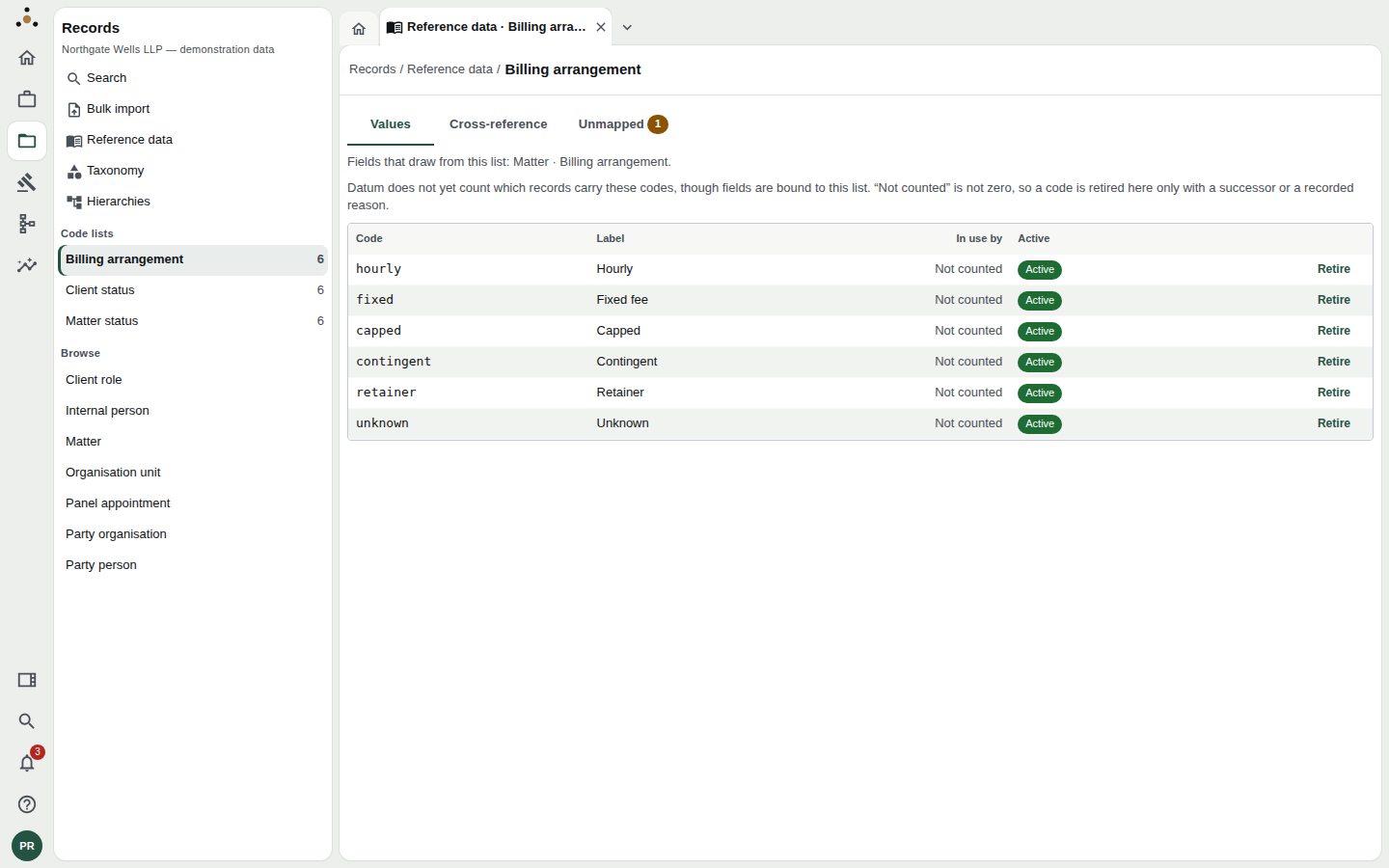
A code list's Values tab: the code, its label, how many records use it, and whether it is active.
The three tabs
Every code list has the same three tabs.
Values
The firm's own vocabulary for this field:
- Code — what is stored on records (
hourly). - Label — what people read (Hourly).
- In use by — how many records carry the code.
- Active or Retired, and for a retired code, Replaced by its successor.
Above the table Datum names the fields that draw from this list — here, Matter · Billing arrangement. A field your role cannot read is not named; the page says that one exists rather than hiding the fact.
You will often see Not counted in the In use by column. It means exactly what it says: Datum does not yet count which records carry the code. It does not mean the code is unused. Read it as "unknown", and retire with care.
Cross-reference
A matrix of source system, their code and our value. It answers: when Elite 3E sends HRLY, what do we store? The answer is hourly. A code with no answer shows Unmapped.
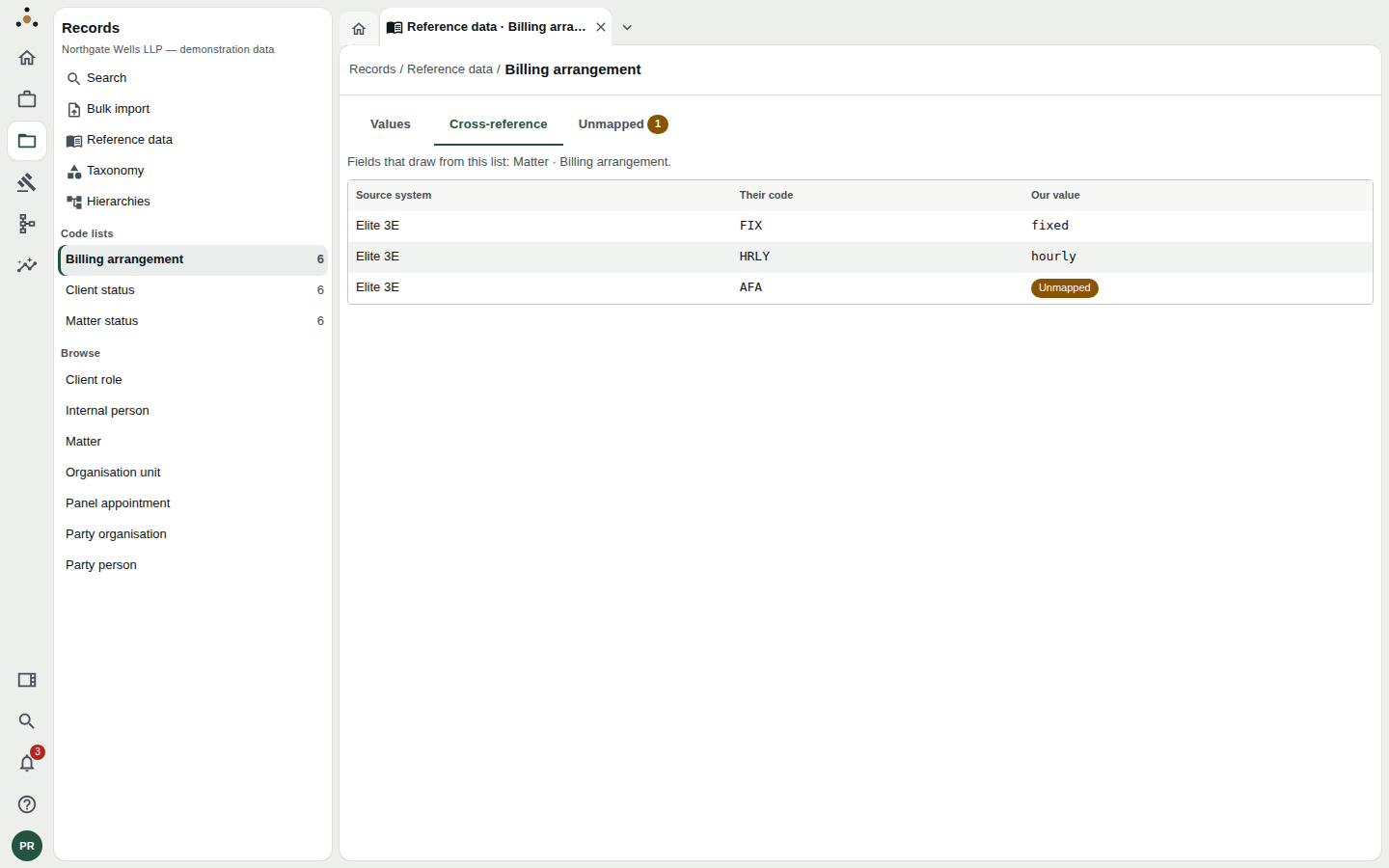
Elite 3E's FIX and HRLY are mapped; AFA has no meaning yet.
Unmapped
The steward's to-do list. Each row is a code that has arrived from a source and has no meaning yet, with the source, how many times it has been seen, and when it was last seen. A count badge on the tab tells you how many wait.
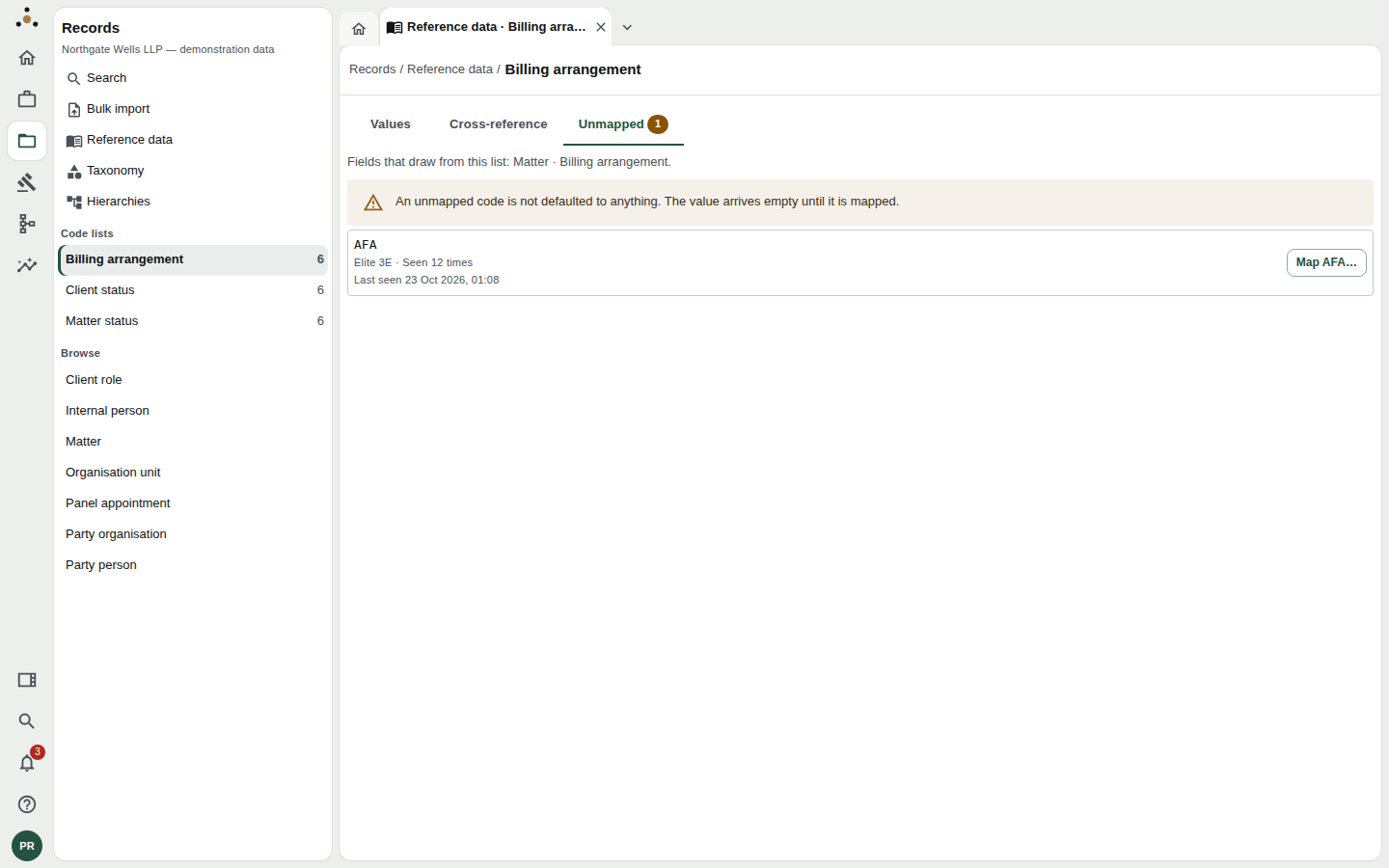
AFA has arrived 12 times from Elite 3E. Until it is mapped, every one of those records carries an empty value.
Datum never guesses. A record that arrives with an unmapped code gets an empty value for that field until you map it. That is safer than a wrong value, but it means unmapped codes quietly cost you data quality. Make a habit of looking at the badge.
Mapping an inbound code
- Open the list, then the Unmapped tab.
- Press Map AFA… beside the code.
- In the dialog, choose Our value — the firm's value this code means. You choose by label; the code beside it is what is stored.
- Add a note if the reasoning is not obvious (optional, kept with the mapping). "AFA = alternative fee arrangement; closest to capped" will save the next steward an hour.
- Press Map the code.
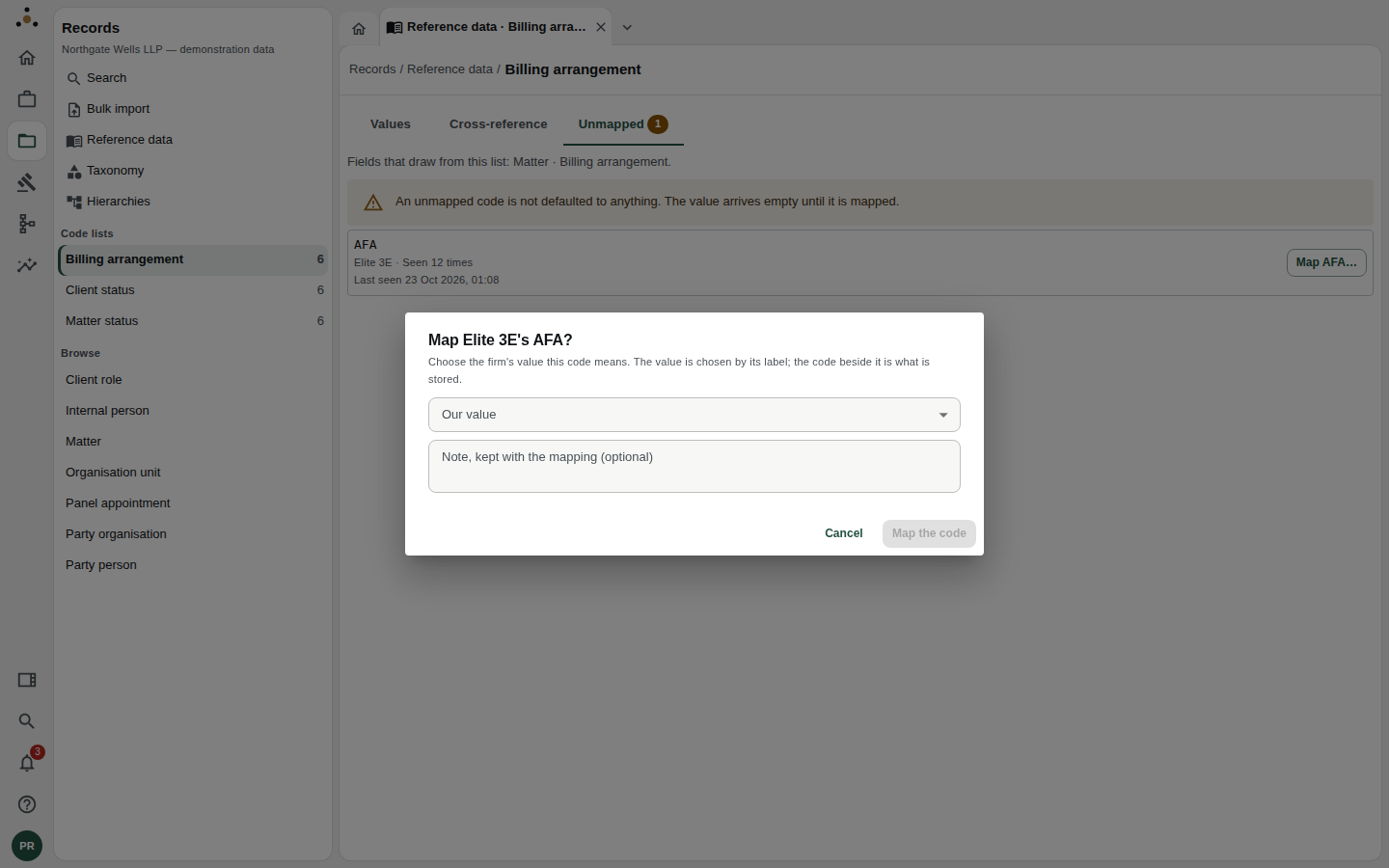
Choosing what the code means.
Datum states the consequence in the dialog: every record that arrives from this system with this code will carry the value you chose. It then adds a sentence you should believe: nothing on this screen undoes a mapping. If you map wrongly, you correct it deliberately — you do not press undo.
If you are unsure what a code means, ask the team that owns the source system. A wrong mapping is silent: nothing errors, the wrong value simply arrives.
Retiring a value
A code that the firm no longer uses — a retired billing arrangement, a superseded status — should be retired, not deleted. Press Retire beside it.
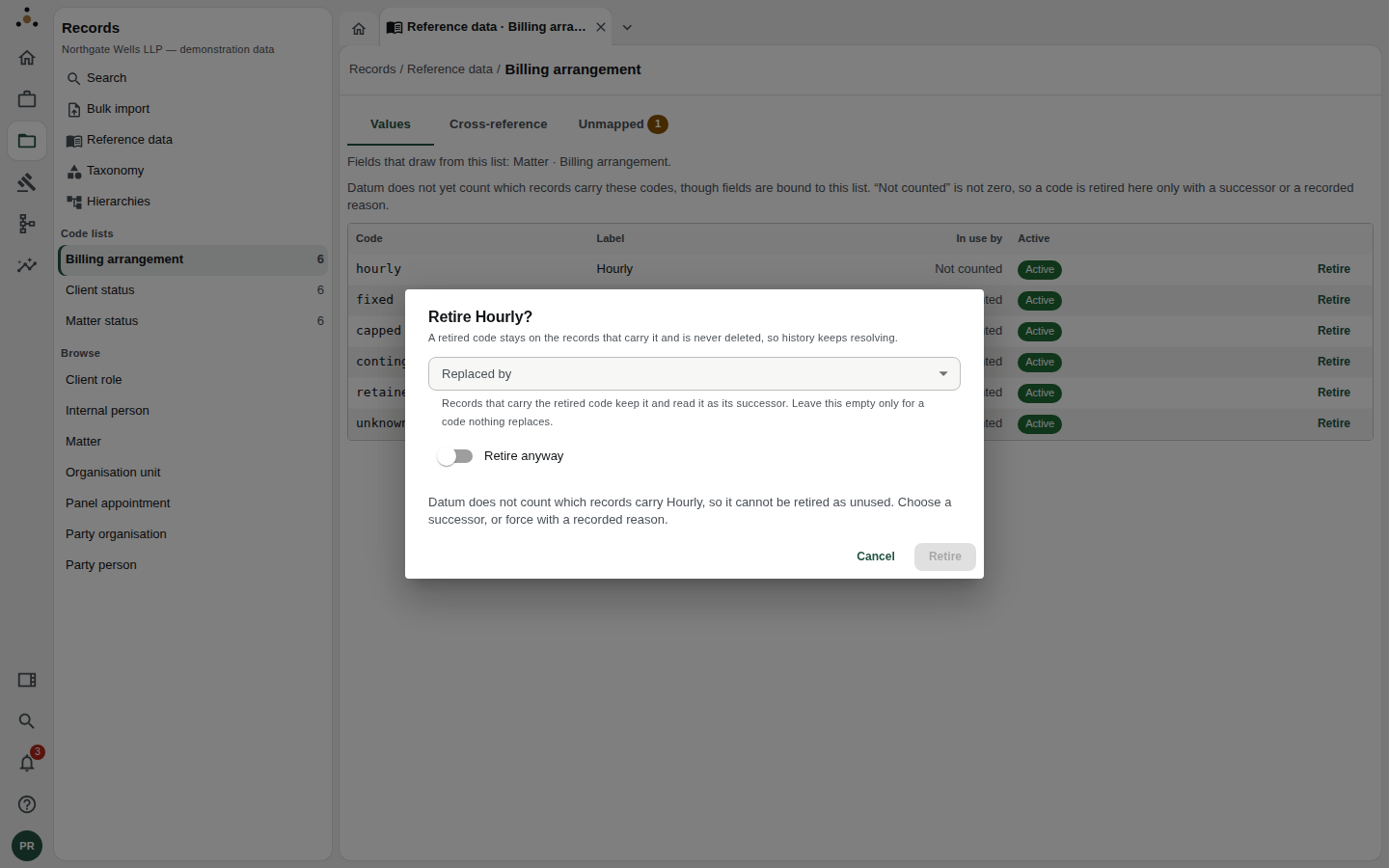
Retiring asks what replaces the code. Without a successor, you must say why.
The dialog opens with a reassurance: a retired code stays on the records that carry it and is never deleted, so history keeps resolving. A record from 2021 still says what it said. What changes is that the code can no longer be chosen going forward, and records carrying it read it as its successor.
You then do one of two things:
- Choose a successor under Replaced by — the normal case.
- Retire anyway, with a recorded reason — for a code that nothing replaces.
Because Datum may not know how many records carry the code, it will not let you retire one "as unused". It says so plainly: Datum does not count which records carry this code, so it cannot be retired as unused. Choose a successor, or force with a recorded reason. If it does know that records use the code and you have not named a successor, you get the same refusal with the count.
A retired code with no successor simply stops being offered. Its old records keep it unchanged.
What other roles see
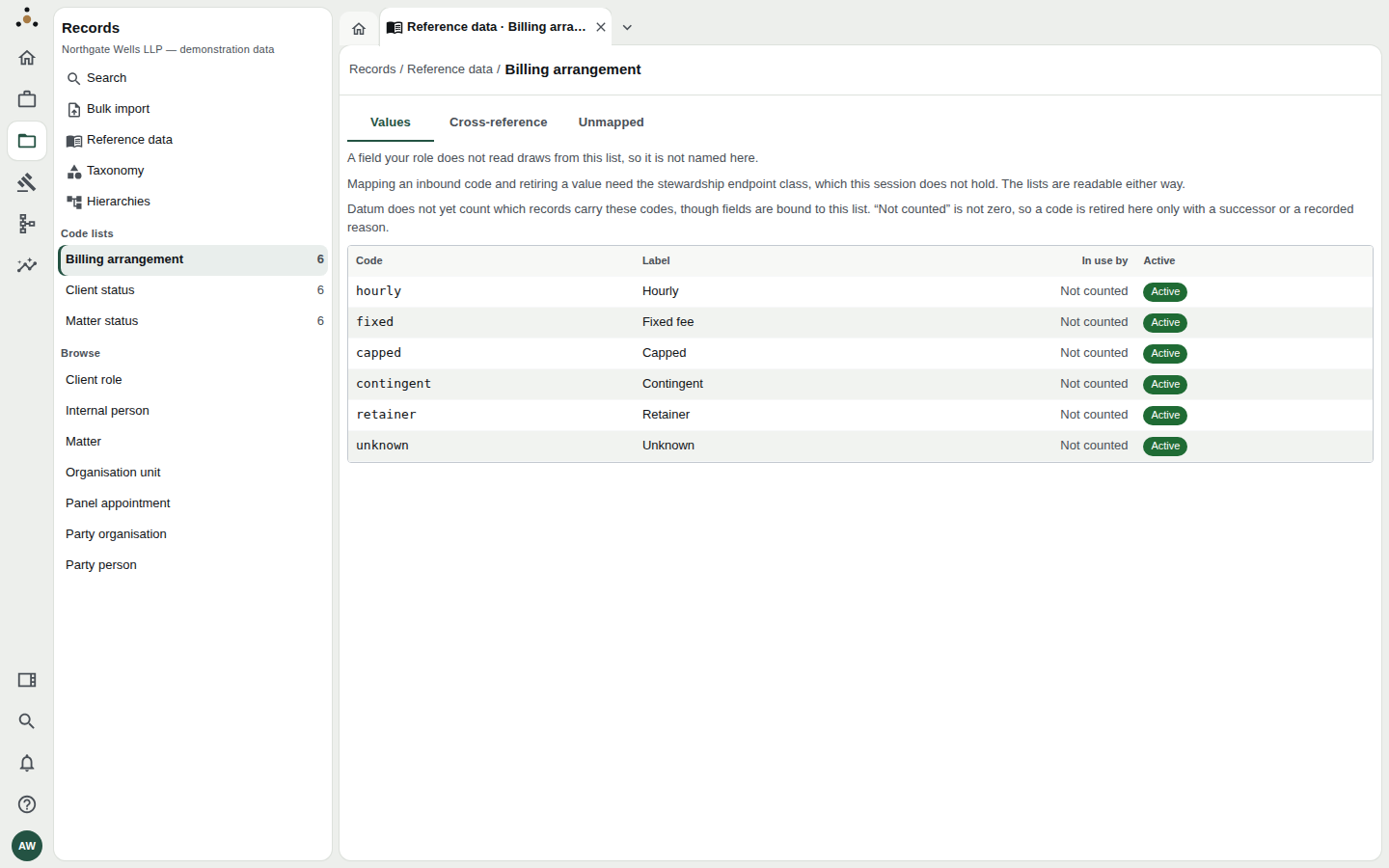
Everyone with read access can browse the lists. Mapping and retiring are stewards' actions.
A fee earner can read every list, which is useful when they wonder what a value means. They are told that mapping an inbound code and retiring a value need the stewardship endpoint class and are offered neither button.
Where reference data fits
Reference data is distinct from the Taxonomy. A code list is a short, firm-owned list of codes (hourly, capped) that source systems abbreviate in their own ways. The taxonomy is a large, hierarchical vocabulary — areas of law, courts, industries — adopted from FOLIO. If your question is "what does the code AFA mean?", you are in the right place. If it is "what is this matter's area of law?", you want the taxonomy.